
5 Tips for preparing for life with dog and baby
Planning for and welcoming a new baby into your life is an exciting time! This new life stage feels huge, and you want to get it right so that your dog and baby can live in harmony.
I can help with some common concerns and worries I hear from expectant and new parents:
· “I feel worried about how my dog will feel when I am splitting my time, attention, and heart between the two.”
· “I feel overwhelmed by my baby prep list and don’t know where to start for my dog prep list.”
· “I feel guilty about my dog’s transition from number one baby to number two and am wondering how to make it smoothly.”
I’m here to boost your confidence with time-saving tips and bust your guilt with enrichment and training advice.
Babies fly through so many developmental phases in their first 2 years. Humans attend 'how to' classes and read 'what to expect’ books—and yet it’s still overwhelming! From the dog’s perspective, there’s a surprise every day as baby features morph. The first few months, baby faces mom. Then baby faces out and suddenly is making eye contact with the dog—with unblinking eyes! Baby learns to sit up. Then crawl. Then wobble walk. Then grab. A baby and toddler’s movements and sounds can be unpredictable and stressful to a dog.
In addition to the family member, the dog's environment and routine changes drastically—Furniture moved around, baby toys (with sounds and lights) added, human play time and snuggle time with dog decreased, number of visitors to home increased.
These 5 tips will jumpstart your preparation!
1. Simple to do list
Set up auto deliveries.
Craft a list of all the items your dog routinely needs: Dry food, wet food, dog chews, dental chews, flea protection, Heartgard, etc. Set up auto ship deliveries with your favorite online or local pet store to lighten your future to do list.
Verify dog’s vaccines are up to date.
Check your dog(s) shot records for due dates, especially rabies (vaccine required by state law). Schedule an appointment before baby comes (if appropriate) or set a reminder on your calendar so the date doesn’t pass you by.
Stockpile doggie pacifiers.
Stock up on puppy pacifiers, such as enrichment feeders and chews. These provide your dog ready entertainment during middle of night feedings or times in the day when you don’t have energy to play.
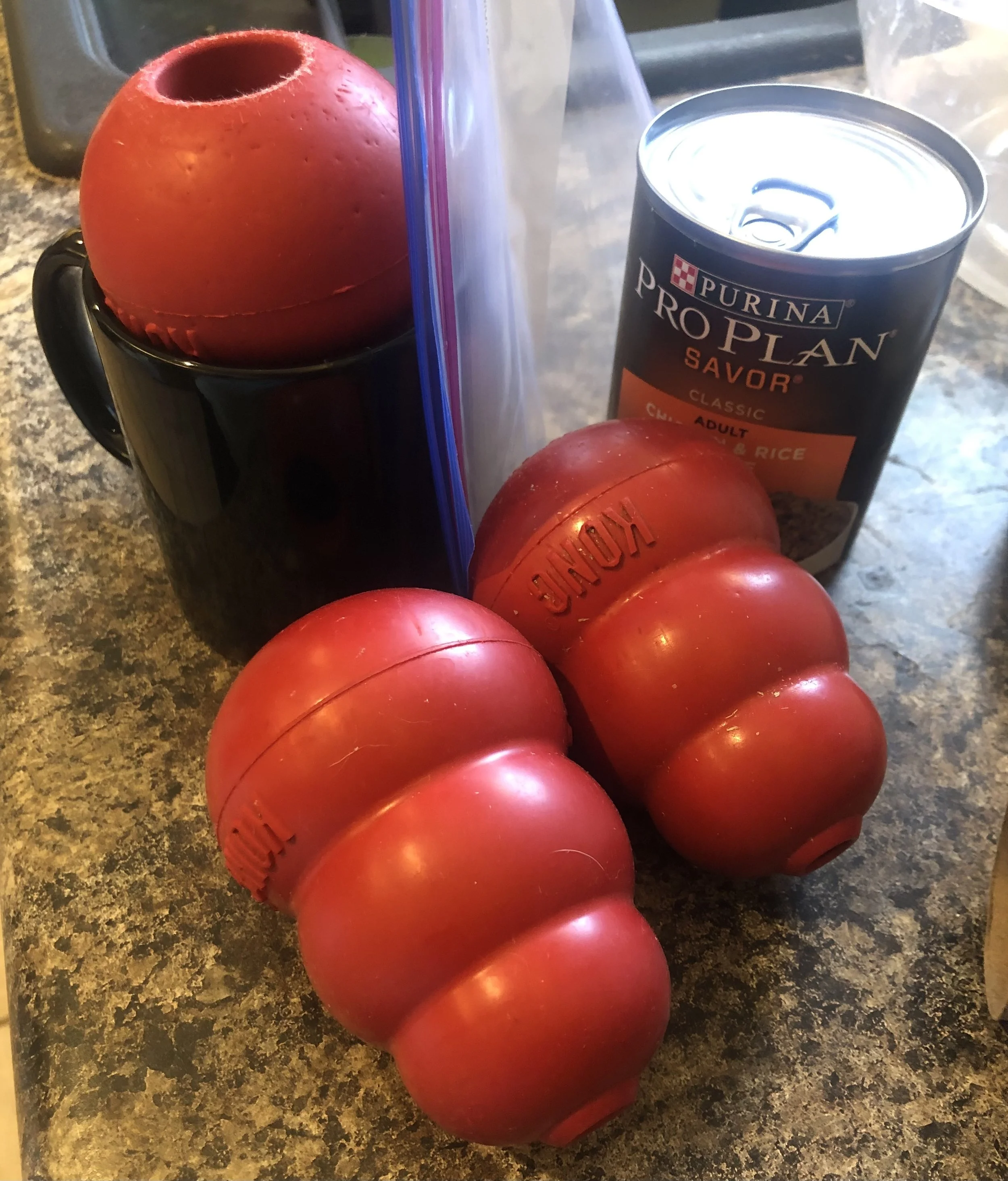
For mealtimes, I love products like the Kong Wobbler or Kong Gyro. You unscrew them, fill with food, and screw shut again. Your dog paw bats and nose nudges them around the house for food to fall out of the hole. This slows down fast eaters and burns a bit of energy.
For baby care times, stuffed Kongs or special chews can be a sanity saver. I like to fill a red rubber Kong with wet dog food and freeze it overnight. I find a standard can of dog food fills 3 size large Kongs. Insert the Kong with the hole upright in a mug, scoop the wet food in with a spoon, then place the Kong in a Ziplock freezer bag to freeze solid overnight. It takes my Hopper about 45 minutes to finish her popsicle Kong. For baby care times when Kongs aren’t ready, offer a special chew that they don’t normally get (ex: No Hide, Bully Stick, Yak Chew etc.). Keep a stash of doggie pacifier chews in the nursery. If baby needs a care task and your dog struggles to settle, offer the chew until task is over and return chew to basket when done.
Consider having two batches of toys, one that is available for play and one that is stored. Every other week, swap them out. The ‘old’ toys are suddenly exciting again.
2. Line up support
Establish a pet sitter and/or boarding facility.
Boarding your dog with a trusted facility, friend, or family member during the first few weeks of your baby’s life lets you focus on baby. Those weeks will be a major adjustment for all. Parents are sleep deprived and trying to establish a new normal routine. Mom may be recovering from delivery and/or a major surgery. Having a trusted dog caretaker means one less family member to keep track of.
Consider utilizing your trusted dog caretakers beyond the first few weeks home to help burn excess energy and shorten your to do list. For dog-social dogs, doggie daycare may be a great option. For dogs that prefer people and quiet, a dog walker is a great option.
Establish a mobile groomer.
A mobile groomer is a great option for dogs requiring regular grooming! They pick up your dog from front door, groom in their vehicle on the street, and return your dog to your front door. No need to travel! Schedule a practice groom before baby comes, so you have one you love lined up for post-delivery. On the other hand, if you already have a brick-and-mortar groomer you love, stick with them!
3. Prepare ahead
Adjust sleep arrangements.
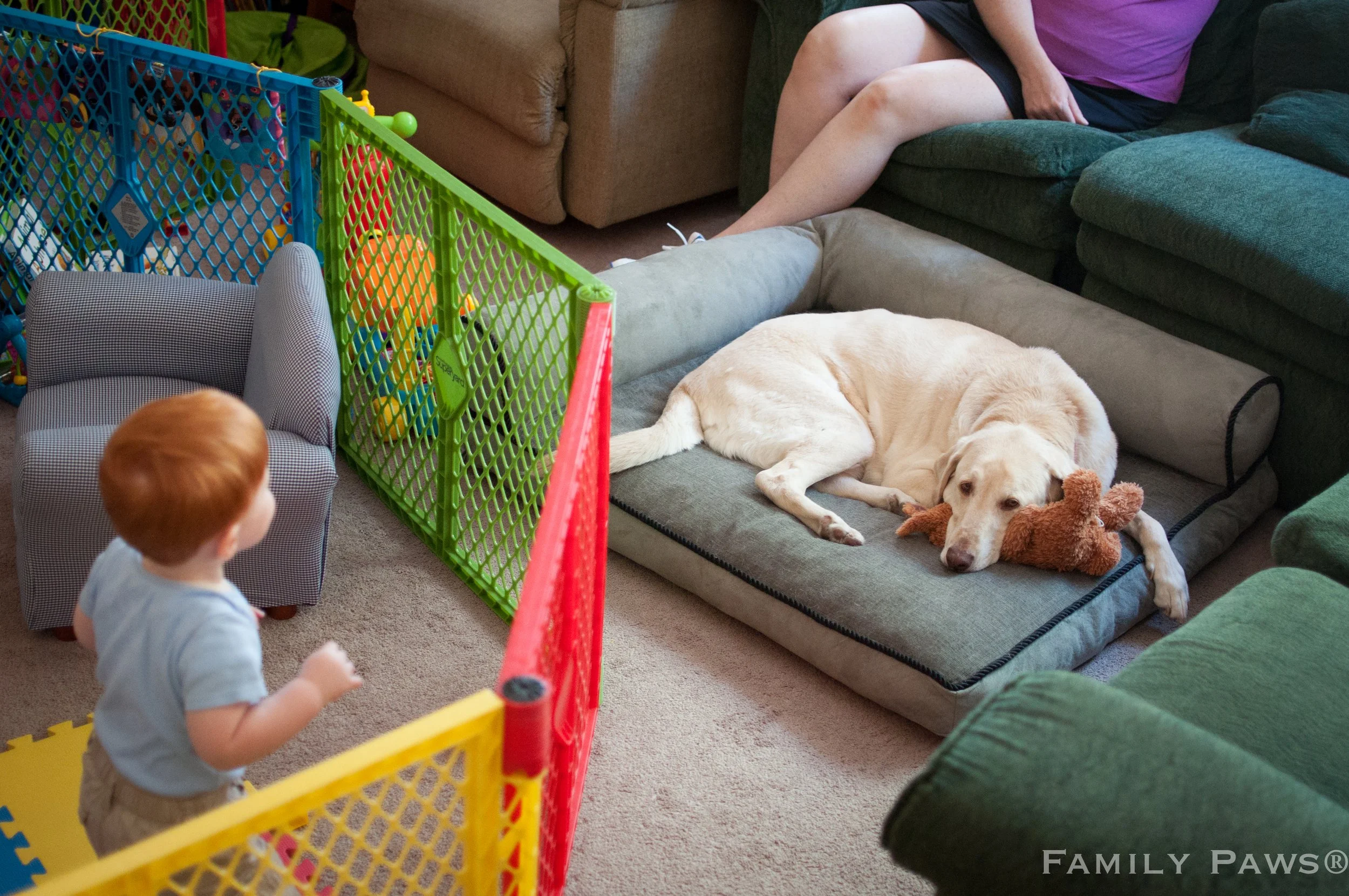
Baby gates, exercise pens, or crates can be a great way to share your room and keep your dog separate from the nighttime activities. You will be sleep deprived and routinely moving about. No dog wants their nose, tail, or toes stomped on. Baby will likely be in parents’ room too, and we don’t want any unauthorized visits from dog. Alternatively, closing the bedroom door to maintain a dog-free zone at night is perfectly acceptable too. Some couples sleep in separate bedrooms, one parent with dog and the other parent with baby.
Rearrange furniture in advance.
Before the baby arrives, set up high-use baby items early (like Pack ‘N Play, baby bouncer, etc.) and rearrange furniture (rocker etc.), providing your dog time to adjust to the novelty. Consider your dog’s personality traits: Sensitive to noise? Baby swings may make humming or motor noises and loud music. Sensitive to objects in motion? Swings sway back and forth. If you discover baby equipment bothers your dog, call me or email me to help! We want your dog to be calm around baby equipment. I also recommend erecting a play yard around the equipment, as much of it might be perfect sniffing height. We don’t need a dog tugging off a baby diaper!
Create your homecoming plan.
Prepare in advance for your dog returning from boarding. When your dog returns home, she will be excited to see her family! Allow her some time to greet and reunite with parents before she sees baby for first time.
Your dog has an AMAZING sense of smell and can smell the baby from across the room. She doesn't need to have her nose on the baby to smell. For example, in the AKC dog sport Nose Work, dogs find a Q-Tip with two drops of birch essential oil hidden in a large room.
In addition to planning for the first day dog and baby are under the same roof, consider the baby’s daily routine. For example, what do you want your dog to do when:
o Returning home from errands with baby in arms?
o Changing baby’s diaper?
o Sitting down feeding baby?
o Tummy time?
o Adult walking around trying to soothe a crying baby?
Examples of other things to think about include:
What skills will you need to teach your dog for them to be able to do what you want in those situations? What rooms will these activities happen in and will dog be allowed in those rooms at all?—or will dog be set up in another space during baby care tasks? What management strategies will you use when you can’t or don’t want to train in that moment?
I want you to err on the side of caution with your dog and baby sharing space. I don’t want your dog to see baby as an exciting new toy to pull blankets off. We want to teach her to be calm around baby. “Dog and Baby on the scene, parent in-between” is my favorite motto for dog and baby sharing space. (Family Paws Parent Education).
As a licensed Family Paws Parent educator, I would be happy to help you craft a homecoming plan and prepare your dog and baby caregivers for life with baby and dog.
As part of your dog and baby preparation, create a set of ‘me time’ index cards. Arrange them by 10 minutes, 30 minutes, 1hr, full afternoon. These are self-care cards that you can select from while another adult has baby care duty. Include a set of activity cards for you and your dog in this stack. You might be missing your guilt-free snuggles with Fido, Netflix and chill time, walks around the block, or your picnics at the park. I want you to keep dosing with those doggie endorphins!
4. Learn to speak dog
“Eyes, ears, tail, muzzle, gather the clues to solve the puzzle” reminds us to look at your dog’s whole body before determining her comfort and stress level in the moment. (Family Paws Parent Education).
It’s especially important to be able to read your dog’s stress levels when there’s a baby in the household. We all notice when a dog growls or shows its teeth and recognize its meaning. We are less likely to notice more subtle signs—like change in ear position, lip lick, yawn, etc. These allow us to intervene early, and to provide praise or guidance to alleviate the dog’s stress and prevent an incident.
If I were talking to you with a big smile on my face, but my knee was fidgeting and I was picking my fingernails and avoiding eye contact, while sweat ran down my face—you likely wouldn’t translate that smile to reflect a calm, cool, collected Rebecca. You would suspect that there was some anxiety. Same with our dogs. A wagging tail doesn’t necessarily mean a happy dog. We need to look at the context of the environment, along with the eyes, ears, tail, and muzzle of the dog to detect how they are feeling and respond accordingly.
For example, if you turn on the baby swing and your dog starts lip licking, yawning, and tucking her tail, you will conclude that the swing is stressing out your dog and invite her to the other side of room, another room, or outside, to get relief from the baby swing. Next, reach out to me, The Family Dog Trainer via email or phone, to build a training plan to achieve more comfort around the swing.
5. Get professional help
Schedule in-home dog training.
I am a licensed Family Paws Parent Educator who will customize a training plan for you to help the addition of baby go smoothly. Let me help you! For example, maybe your dog is a door dasher, which can be a problem when opening the door to all the extra deliveries and new visitors. Or if your dog is a nervous nelly around new people, and you’re anticipating lots of helpers and visitors with new baby. Maybe your dog plays tug every night on the very rug you plan to do tummy time. Maybe your dog likes to paw you for attention, and you worry about that happening while feeding baby. Knowing your dog’s personality, routine, and quirks, we can predict what aspects of life with baby might be challenging and prepare your dog with a customized training plan. Old dogs can learn new tricks because dog training is for life! I’m happy to offer support to parents and their dogs from expecting baby to baby’s arrival to the toddling years—and beyond!
A few training tips to get you started:
Practice known behaviors while changing your appearance. For example, hold a doll swaddled in a blanket and ask your dog to ‘sit’. Holding a baby changes how you look to your dog. You could also hold a loaf of bread in a blanket (to represent something with an interesting smell) and ask your dog to ‘down’. We tend to only cue our dogs to do something while we are standing and our hands are free. Yet baby caretakers will be sitting with baby for feeding time etc., so we want to practice those scenarios. You can also practice passing the new ‘bread baby’ to someone else, while asking dog to offer a behavior. Being able to give your dog cues and she comfortably and efficiently respond helps your dog and family navigate this new roommate situation.
Practice separation. Teaching a dog to settle on a mat, in a crate, or on the other side of a baby gate is a sanity saver. Before a baby, your dog was likely your little shadow. Following you from room to room, snuggling in your lap when you sit down, pawing you for attention, bouncing in your face when you kneel on the floor, sharing your bed overnight, etc. Once baby arrives, these routines may feel more disruptive and your dog being comfortable at settling on mat can make these routine changes smoother.
Because you love your dog and kid so much, it's natural to want to see immediate harmony. But relationships take time. It’s more important to help your dog develop neutral and positive associations with baby at the start and then work on the friendship factor and physical interactions when they're older.
CONCLUSION
I’m proud of your desire to set your dog up for success with the addition of a baby! This is a new stage of life for both you and your dog. I want to be there to cheer you on! Harmony is possible with preparation, management, and training. Email or call me to take a load off your to do list. I offer in-home private lessons, where I come to your home and teach you how to train your dog. Not local to Lubbock, Texas? I happily support families with live virtual lessons from the comfort of your own living room.